
What Home Service Business Owners Need to Know About Fake Compliance Notices in 2026
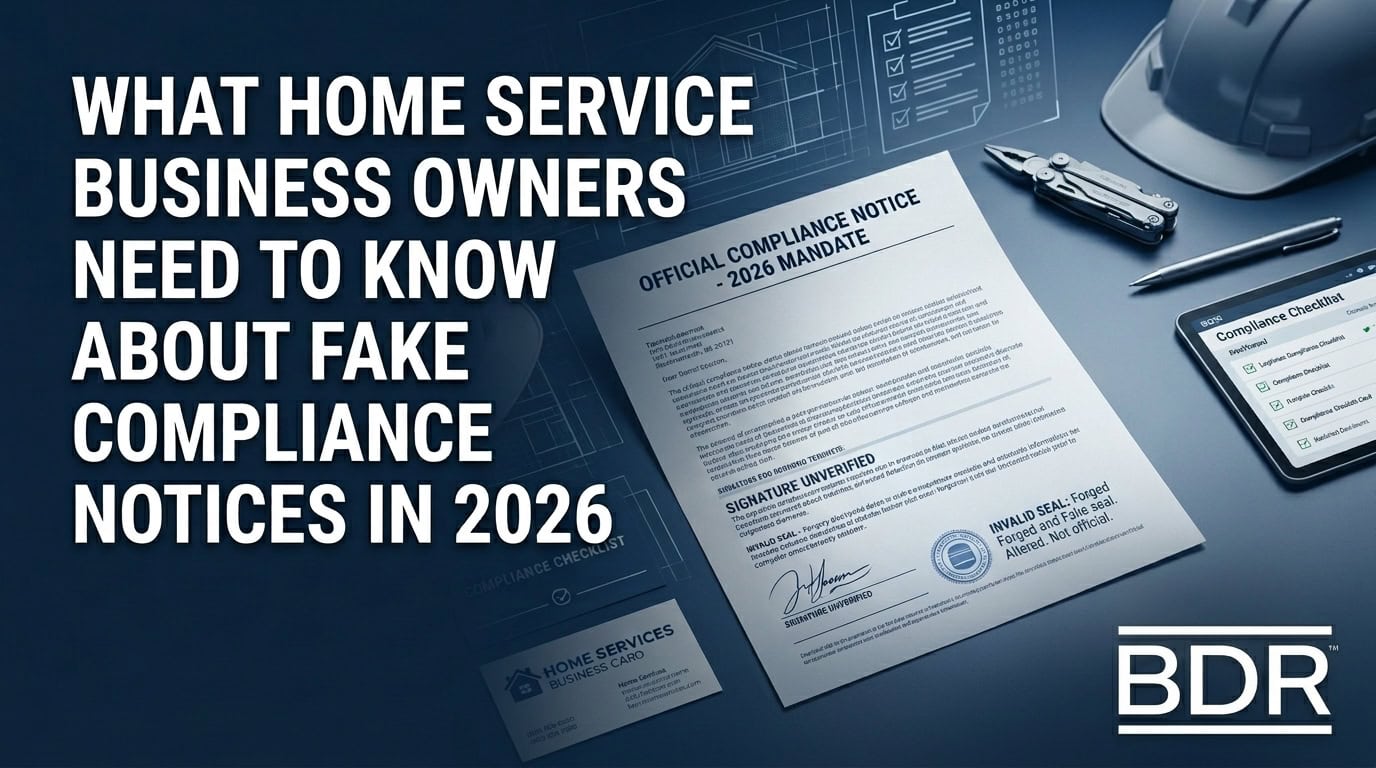
Across the United States, home service business owners are receiving official-looking letters, emails, and text messages that claim to be from government agencies.
These communications typically feature government-style seals, case numbers, and urgent language warning of penalties for regulatory non-compliance. In most cases, they’re fraudulent.
The Better Business Bureau updated its scam alert in September 2025, confirming that fake compliance notices continue to target small businesses nationwide. Multiple state attorneys general, including those in Washington and Pennsylvania, have issued fresh warnings.
The Federal Trade Commission issued a dedicated consumer alert about government impersonators mailing fake notices to business owners. That alert remains active today because the problem has only escalated.
How to Spot Fake Compliance Notices Before They Cost Your Business
HVAC, plumbing, and electrical contractors are particularly at risk. These businesses have real compliance obligations, tight schedules, and often limited administrative support. Scammers know this, and they’re counting on busy owners not taking the time to verify what lands in their mailbox.
This article covers how these scams have evolved in 2026, the new tactics they are using, and the specific steps you can take to protect your business.
Why These Fake Compliance Scams Are More Convincing Than Ever
The fundamentals haven’t changed. Scammers send letters, emails, or text messages that mimic legitimate government agencies.
They use official-sounding names, reference real statutes, and create urgency with phrases like “FINAL NOTICE” or “IMMEDIATE ACTION REQUIRED.”
What has changed in 2026 is how sophisticated these schemes have become.
Scammers now combine publicly available business filing data with information from data breaches. That combination means they can address you by name, reference your actual EIN or filing date, and make the letter feel deeply personal. When a notice arrives with your real business details printed on it, the instinct to trust it is strong.
Some of these schemes also reference real regulations. They’ll cite actual statute numbers or agency names that sound close to real ones, but with slight variations. The goal is to create just enough familiarity that you don’t question it.
The Corporate Transparency Act Angle
One of the biggest new developments since 2024 is scammers exploiting confusion around the Corporate Transparency Act (CTA) and Beneficial Ownership Information (BOI) reporting.
Here’s what happened. The CTA introduced new reporting requirements for many small businesses. Scammers immediately started sending fake notices demanding BOI filing fees, even though reporting to FinCEN is free. These fraudulent letters reference a made-up “Form 4022” from a fictional “United States Business Regulations Department” and demand payments of $117 or more.
Some of these notices go further. They threaten daily civil penalties of $591, total fines up to $10,000, and even criminal charges for non-compliance. For a contractor who’s heard vaguely about new federal reporting requirements but hasn’t looked into the details, this kind of letter feels terrifyingly real.
The important update: as of March 2026, FinCEN removed BOI reporting requirements for U.S. companies and U.S. persons. Domestic businesses no longer need to file. Any notice telling you otherwise is fraudulent. Period.
Fake Entities to Watch For
Knowing the names scammers hide behind makes them easier to spot. Here are some of the fraudulent entities that have been reported by the BBB, state attorneys general, and the FTC:
- “Department of Legal Compliance” sends official-looking compliance notices demanding payment for fictitious regulatory requirements
- “US Claim Registry” targets newly registered businesses with fake government forms requesting sensitive information and fees
- “United States Business Regulations Department” is the fictional agency behind many CTA/BOI scam letters
- “Corporate Compliance Center” sends annual report and compliance renewal solicitations that mimic state Secretary of State filings
- “Business Compliance Division” uses official-sounding language to pressure business owners into paying unnecessary fees
None of these are real government agencies. If you receive anything from an entity you don’t recognize, verify it directly through your state’s Secretary of State website or the relevant federal agency’s official site. A quick search is all it takes to confirm whether a notice is legitimate.
Red Flags That Give Scam Notices Away
Even the most convincing fake notices have tells. Train yourself and your office staff to look for these warning signs:
- Urgency language. Phrases like “Act immediately,” “Final notice,” or “Failure to comply will result in fines.” Real government agencies give you time and follow formal processes before taking action.
- Payment demands via mail. Legitimate agencies don’t demand payment through unsolicited letters with vague penalties. They certainly don’t ask you to wire money or pay with gift cards.
- Requests for sensitive information. Tax IDs, banking details, Social Security numbers, or signatures requested through mail or email are major red flags. Real agencies already have your EIN on file.
- Unfamiliar agency names. If you can’t find the sending agency on an official .gov website, it’s not real. Scammers count on the name sounding close enough to something legitimate.
- Contact details that don’t match. Don’t call the phone number on the notice. Look up the real agency’s number independently and call that instead.
Practical Steps to Protect Your Business
Verify every unexpected notice at the source. Go directly to the agency’s official website. Type the URL yourself rather than clicking a link in the letter or email. Call the official number listed on the .gov site. This single habit eliminates most scam risk on its own.
Train your front office team. Whoever opens the mail or manages the business inbox is your first line of defense. Give them a clear rule: any notice that demands payment, threatens penalties, or requests sensitive information gets flagged for review before anyone takes action. Make it a standing policy, not just a one-time conversation.
Use official channels for all filings. Renew licenses, file annual reports, and handle compliance directly through your state’s Secretary of State website or the relevant federal portal. Bookmark these sites so you’re never guessing about the right URL.
Monitor your business filings regularly. Check your records with state and federal agencies at least quarterly. When you know your filings are current, a surprise “non-compliance” notice immediately looks suspicious. That confidence is your best defense.
Report scams when you find them. File a report with your state’s Attorney General, your local BBB, and the Federal Trade Commission. Every report helps build a trail that protects other business owners from the same scheme. It also gives law enforcement the data they need to shut these operations down.
Common Questions About Fake Compliance Notices
Q: I received a compliance notice in the mail. How do I know if it’s real?
A: Start by looking up the sending agency on an official .gov website. If the agency doesn’t exist there, the notice is fake. Legitimate government agencies also don’t demand immediate payment by mail, ask for sensitive information like Social Security numbers or bank details, or threaten vague penalties with short deadlines. When in doubt, call the real agency directly using the phone number from their official website, not the number on the letter.
Q: My business just filed with the state. Why am I suddenly getting so many of these letters?
A: Business registration data is public record. Scammers monitor new filings and target businesses within the first 30 to 60 days, when owners are less familiar with what legitimate government correspondence looks like. This timing is intentional. If you’ve recently formed an LLC, registered a DBA, or filed any state paperwork, expect that scam solicitations will arrive. The amounts are often small enough to seem inconsequential, which is exactly what makes them effective.
Q: Do I still need to file a Beneficial Ownership Information (BOI) report?
A: If your business is a U.S. company owned by U.S. persons, no. As of March 2026, FinCEN removed BOI reporting requirements for domestic businesses. Any notice claiming you need to file a BOI report and pay a fee is fraudulent. Reporting to FinCEN was always free, and it’s no longer required for most U.S. businesses. Only certain foreign-owned entities still have filing obligations.
Q: What should I do if I already paid a fake compliance notice?
A: Report it immediately. File a complaint with your state’s Attorney General, the Better Business Bureau, and the FTC at reportfraud.ftc.gov. Contact your bank or credit card company to dispute the charge. If you provided sensitive information like your EIN, Social Security number, or banking details, monitor your accounts closely and consider placing a fraud alert with the major credit bureaus. Acting quickly gives you the best chance of recovering funds and limiting further exposure.
A Special Note for Newly Registered Businesses
If you’re in the process of starting or restructuring your business, expect scam solicitations to arrive shortly after filing. Be especially cautious with any correspondence that arrives in the first 60 days.
In short: verify everything. The best protection is simply knowing that these letters are coming.
Stay Informed and Stay Protected
Fake compliance notices aren’t going away. Scammers are getting smarter, using real business data, exploiting regulatory confusion, and targeting contractors who are too busy to stop and verify. The good news is that these scams fall apart the moment you check the source.
Build a simple verification habit into your office routine. Train your team. And when something feels off, trust that instinct. A two-minute phone call to the real agency beats a $200 payment to a scammer every time.
At BDR, we help home service business owners build stronger, more resilient operations. Protecting your business from scams is one part of that picture. Building the systems, training, and leadership that make your company thrive is the bigger one.
Reach out to the BDR team to learn how our coaching and training programs can help you run a more profitable, better-protected business. Or you can also call our helpful team at (206) 870-1880 to get started.
Share This Blog